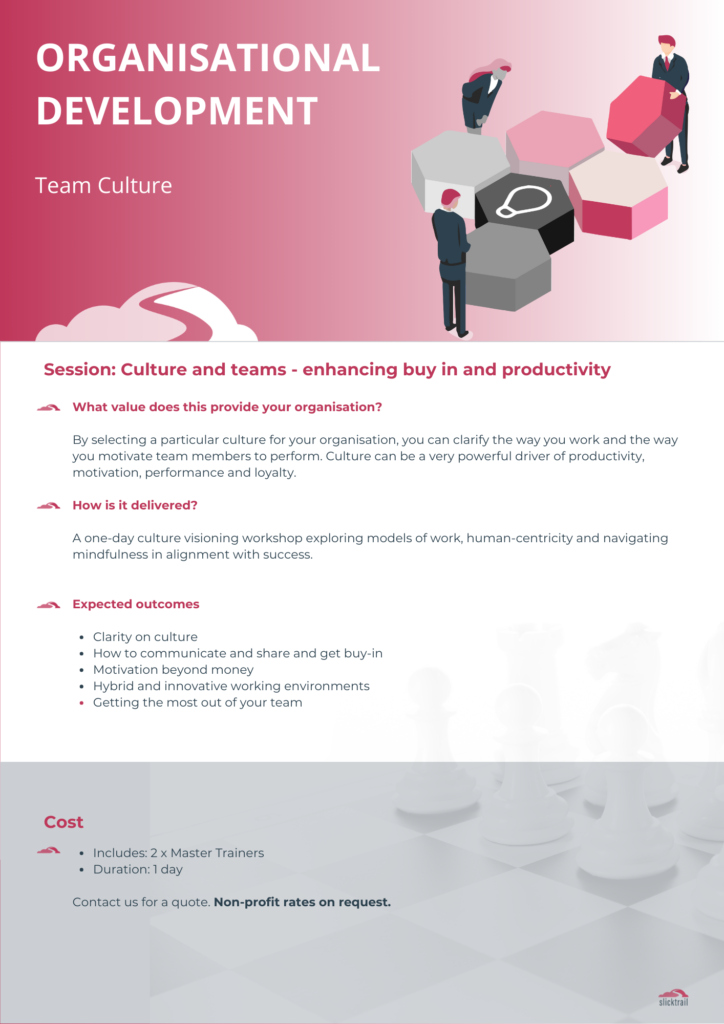
WHAT WE DO

Create a Human-centric Workplace

Historically, organisational development has focused on the implementation of systems to improve productivity. However, our experience has shown that a human-centric approach to culture development and strategic implementation proves to be far more effective and long-lasting. Advancements in technology continue to change the way in which we work and/ or can access work. Our first foray into remote working environments, brought on by the pandemic, highlighted the possibilities of remote working in still being able to achieve objectives, whilst encouraging organisations to rethink their strategy and offering. A merging of traditional work environments with remote/ digital spaces has resulted in a hybrid model whereby in-person gatherings or in-office days are included in the working week. Adapting to this way of working – fully remote or hybrid working environments – can be challenging.

OUR APPROACH

Our approach to creating human/person centred work environments is underpinned by a humanising pedagogy – “A humanising pedagogy has to develop the kind of teaching and learning interface that enables agency, a sense of coming not only to know, but to own the knowledge and be empowered by it.”

In reality, this is more than ensuring everyone is merely informed, instead, it is seeing each person’s contribution as a valuable part of the day-to-day operations, the deliverables, and the greater vision of the organisation. It is also seeing team members within and outside of their roles in the organisation – and expanding the environment to include the many different roles we all play. 


Creating a human-centric workplace culture is modelled, very closely, on the principles of ubuntu – that we are stronger, together. 

As an underpinning principle, interventions designed and implemented focus on: 

  • Authenticity: safe spaces for honesty; authentic offerings that seek to educate and promote mindfulness; and not offend
  • Contextualising: relevance to self; team; organisation
  • Unlocking narratives: of self, team and organisation 
  • Building resilience through understanding and processing 
  • Intergenerational principles – reframing talent management and succession planning to focus on learning from each other and learning together 
  • Compassionate accountability
  • Leadership/ agency: redefining roles and responsibilities to create greater opportunity for ideas to be shared, owned and embraced 
  • Co-creation and collaboration: building opportunities for all voices to be heard and all team members to contribute/ be involved in overall decision-making and strategic planning 
  • Unlocking wisdom and tapping into experience: considering the impactful role the many different talents people hold and how they can contribute meaningfully to the goals/ vision of the organisation. 

Adapting to a fully digital or blended/ hybrid model of working is not without its challenges. However, we’ve found, the benefits far outweigh the risks. Apart from the obvious financial benefits (e.g. elimination of office rent, equipment and furniture costs), digital and/ or hybrid models allow for a higher degree of flexibility and accessibility. Digital and/ or hybrid models of work are output-driven, not time-bound. With the right team in place (individuals best suited for the roles), a culture built on trust and accountability, flat structures, collaborative decision making, and shared commitment (and responsibility), digital teams can thrive. 

  • Keys to communication
  • Aligning and onboarding teams
  • Stimulating creativity
  • Nurturing innovative thinking

Stimulating the growth potential of your team and creating an environment for continuous learning is an important element of an organisation’s success. Building capacity is more than the practical skills training related to a specific role or function, it is also the soft and interpersonal skills needed to function as a team, show up in our authentic selves, and create safe spaces for powerful and effective communication. Skilled teams generate greater ideas, promote overall growth and work more cohesively as a unit. Encouraging the sharing of knowledge, wisdom and experience is a significant factor in building effective strategy. 

  • Kaos Pilots method for crafting and facilitating learning spaces
  • Blended approach to capacity building:
    • Online
    • Group coaching
    • Masterclasses
    • In-person training

SESSION EXAMPLES

Sessions can be customized according to your requirements

Culture and Teams